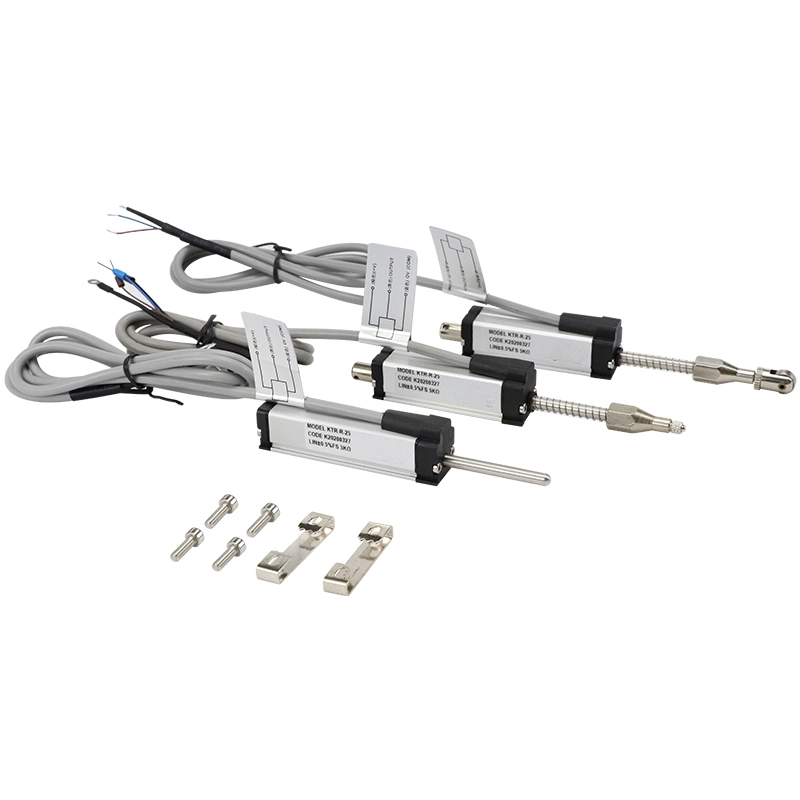
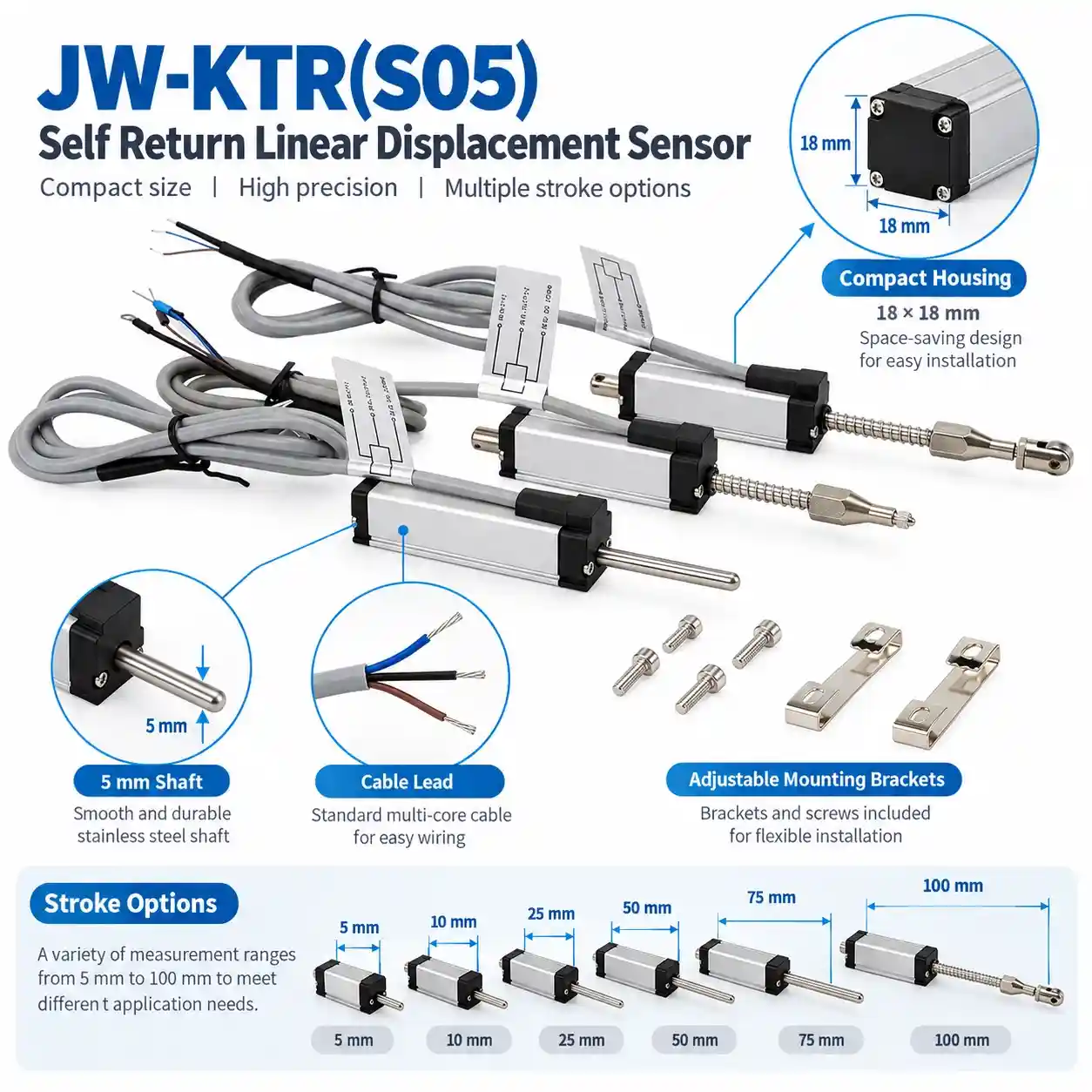
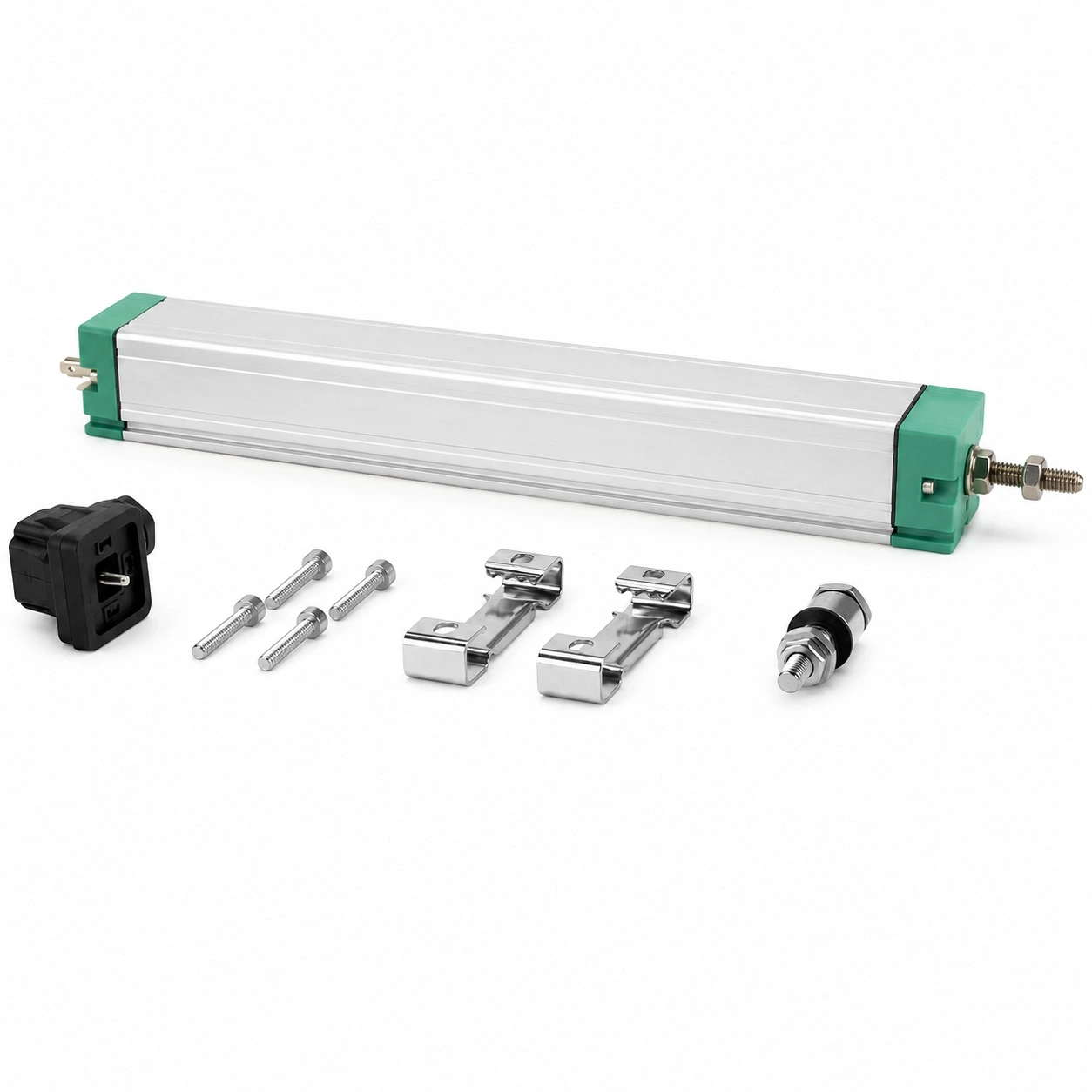
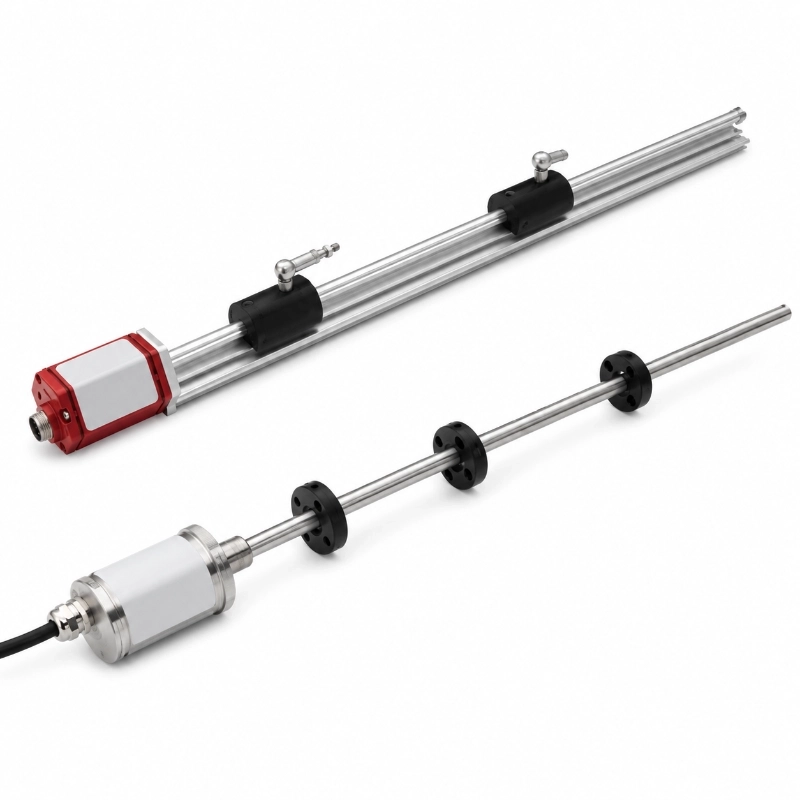
O JW-KTR(S05) Self Return Linear Displacement Sensor is a compact spring-loaded position transducer designed for short-stroke displacement measurement in industrial machinery and testing equipment.
Featuring a conductive plastic potentiometer, built-in return spring, stainless steel measuring shaft and anodized aluminum housing, the sensor converts linear contact movement into a proportional electrical signal.
Com cursos de medição selecionáveis a partir de 5mm to 100mm, an 18 × 18mm housing profile and IP65 protection, the KTR sensor is suitable for thickness inspection, flatness measurement, compact machine positioning, mechanical testing and industrial automation.
Unlike conventional rod-type linear position sensors that require a mechanical connection to drive movement in both directions, the spring return displacement sensor can retract automatically after the applied contact force is released.
1. How Does a Self Return Linear Displacement Sensor Work?
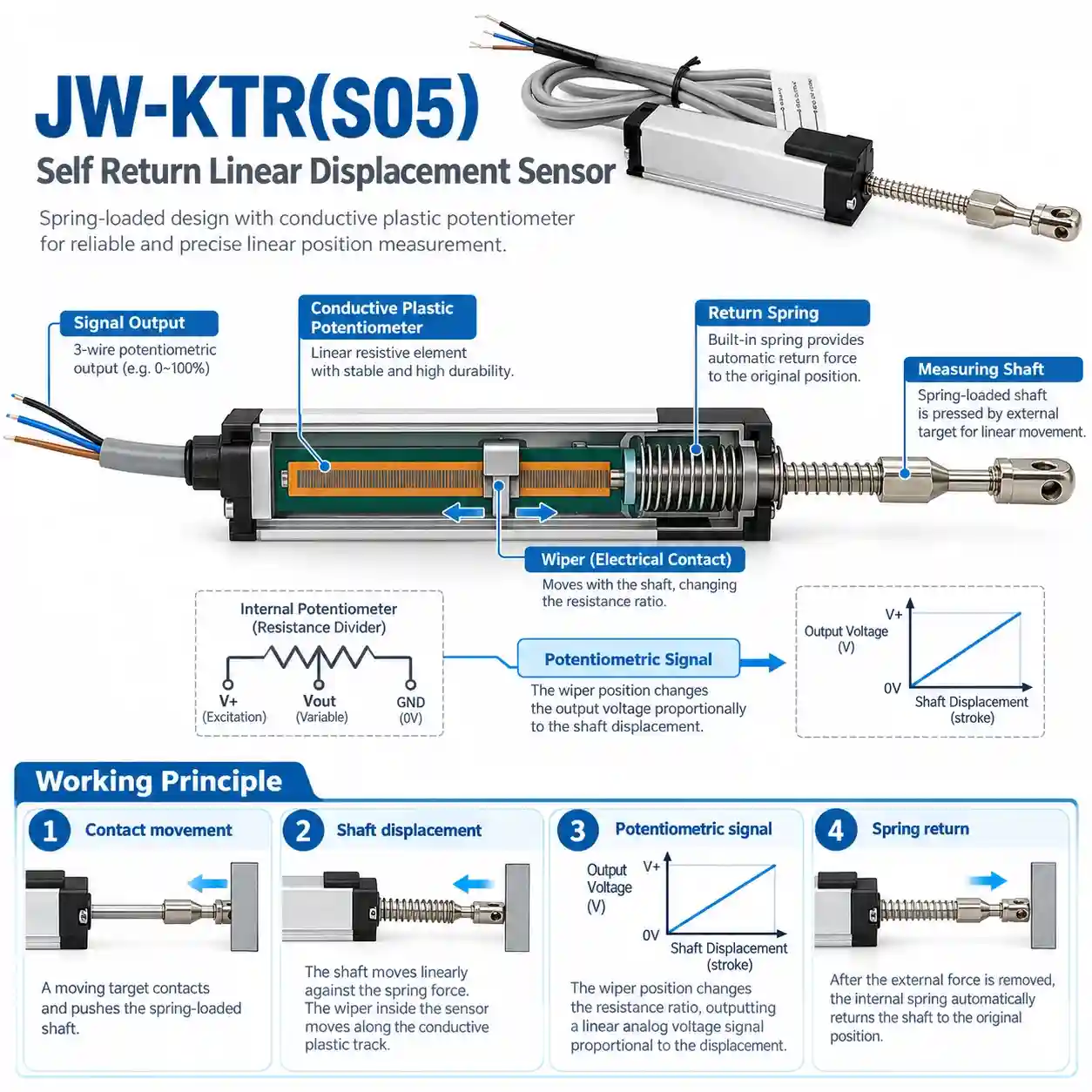
A sensor de deslocamento linear com mola uses a measuring shaft, internal potentiometric sensing element and return spring.
When a moving object presses the measuring shaft, the shaft moves along the sensor’s measurement axis.
This movement changes the position of the internal sliding electrical contact along the conductive plastic resistive element.
The sensor produces an electrical signal corresponding to the shaft displacement.
When the external force is removed, the return spring moves the shaft back toward its initial position.
Contact Movement → Shaft Displacement → Potentiometric Signal → Spring Return
Why Use a Spring-Return Mechanism?
A conventional linear potentiometer generally requires mechanical coupling to drive its measuring rod.
The KTR self-return design is useful when the measurement involves intermittent contact, a moving surface or a short-travel mechanism where a fixed two-way mechanical linkage is impractical.
The spring-return structure is particularly relevant for:
Contact displacement inspection
Medição da variação da espessura do material
Surface height comparison
Mechanical fixture testing
Short-stroke machine movement monitoring
The available spring force and contact-tip geometry should be verified for applications involving delicate or deformable materials.
2. Especificações Técnicas
Parâmetro
Especificação
Modelo
JW-KTR(S05)
Série
KTR
Tipo de sensor
Spring-Loaded Linear Potentiometer
Medição do AVC
5–100 mm
Princípio de Medição
Conductive Plastic Potentiometer
Linearidade
±0.05%, as listed in technical table
Repetibilidade
Less than 0.01mm
Resolução
Continuous Analog; Theoretical
Opções de resistência
2kΩ / 5kΩ
Tolerância à resistência
±20%
Minimum Load Resistance
100kΩ
Listed Allowable Voltage
28V maximum
Conexão elétrica
Direct Cable
Velocidade de deslocamento
Less than 3m/s
Vida Mecânica
More than 50 Million Cycles
Housing Profile
18 × 18mm
Material de construção
Anodized Aluminum
Measuring Shaft
Aço inoxidável
Shaft Diameter
5mm
Montagem
Adjustable Bracket
Classificação de proteção
IP65
Temperatura de operação
-40°C a +80°C
Nota técnica: The product feature summary also references linearity up to 0.1%, depending on stroke. Confirm the applicable linearity specification for the selected model. The listed 28V maximum is not a universal supply requirement for optional output modules.
3. Output Signals and Controller Integration
3.1 Potentiometric Resistance Output
The standard KTR sensing element provides a position-dependent resistance or voltage-divider signal.
Available resistance values include:
2kΩ
5kΩ
A suitable receiving circuit is required to interpret the potentiometric signal.
3.2 Optional Analog Outputs
Signal-conditioning configurations may provide:
4–20mA
0–5V
0–10V
These signals can be connected to compatible PLCs, industrial controllers and data acquisition systems.
3.3 RS485 Output Option
RS485 is listed among the optional signal configurations.
Communication protocol support, electrical supply and interface documentation must be confirmed for the selected version.
Typical monitoring arrangement:
KTR Displacement Sensor → Signal Conditioning → PLC / Data Acquisition System → HMI
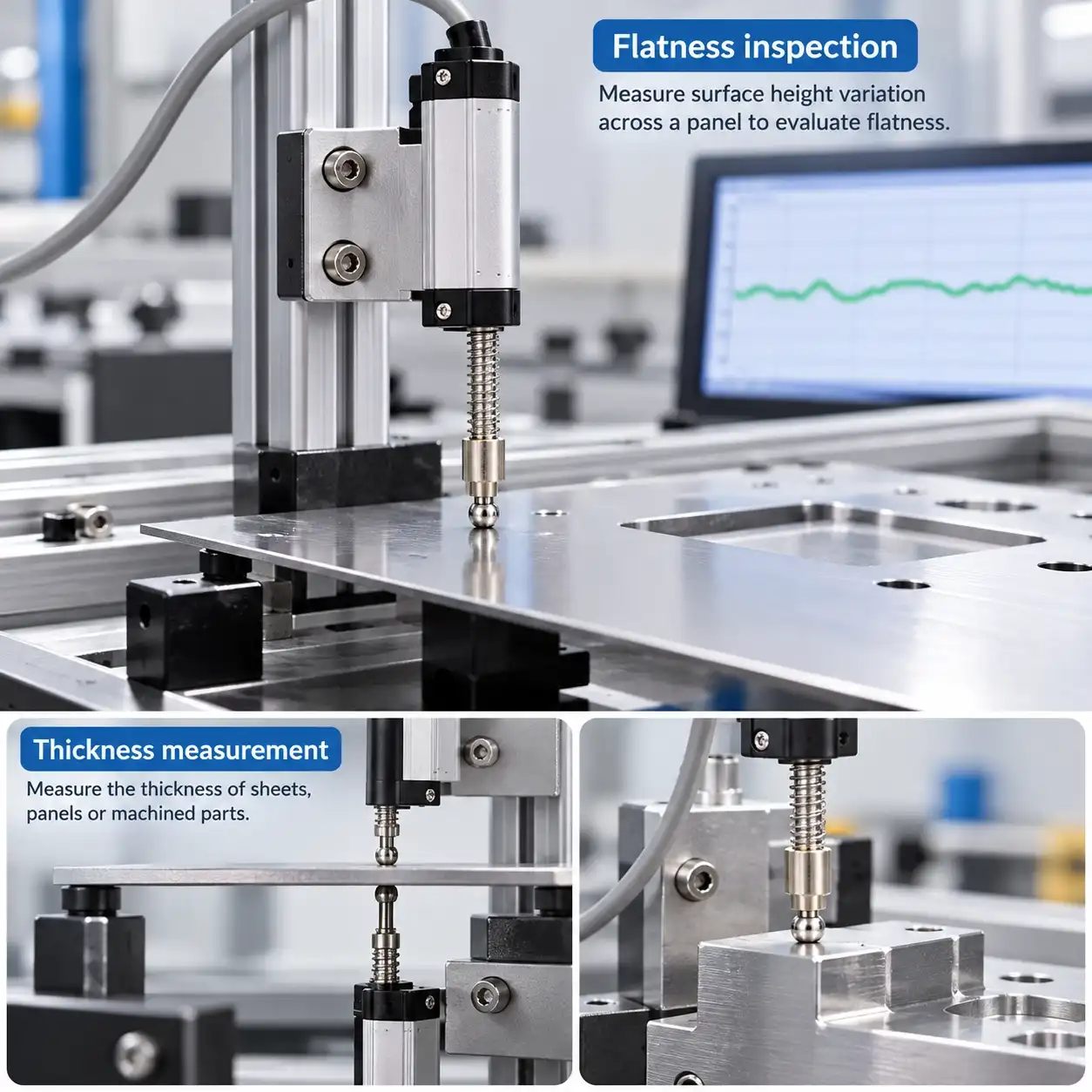
The self-return measuring shaft can be used to monitor relative surface height changes in suitable inspection fixtures.
As a target contacts the shaft, the sensor provides a displacement reading relative to its reference position.
A testing system may use this measurement to evaluate local height differences across a component.
4.2 Thickness Measurement
A spring-loaded linear displacement sensor can measure relative mechanical movement associated with material thickness in a properly designed measurement fixture.
As aplicações podem incluir:
Sheet material thickness variation
Panel inspection
Mechanical clearance checks
Component dimensional testing
Measurement performance depends on fixture design, contact force, alignment and calibration.
4.3 Packaging and Printing Machinery
Packaging and printing equipment often contains short-travel mechanical assemblies.
The KTR sensor may be used for compact position feedback, contact displacement and selected machine adjustment measurements.
Its self-return structure can be useful where the monitored component contacts the measuring shaft during a machine cycle.
4.4 Valve and Small Mechanism Position Monitoring
Suitable valves and compact mechanical actuators may require short-stroke position monitoring.
The sensor can track shaft displacement where the return spring, contact geometry and mechanical forces are compatible with the application.
4.5 Industrial Testing and Automation Fixtures
The KTR series can support mechanical testing equipment, automated inspection stations and compact machine fixtures.
Applications should be evaluated according to required measuring stroke, repeatability, operating speed and environmental conditions.
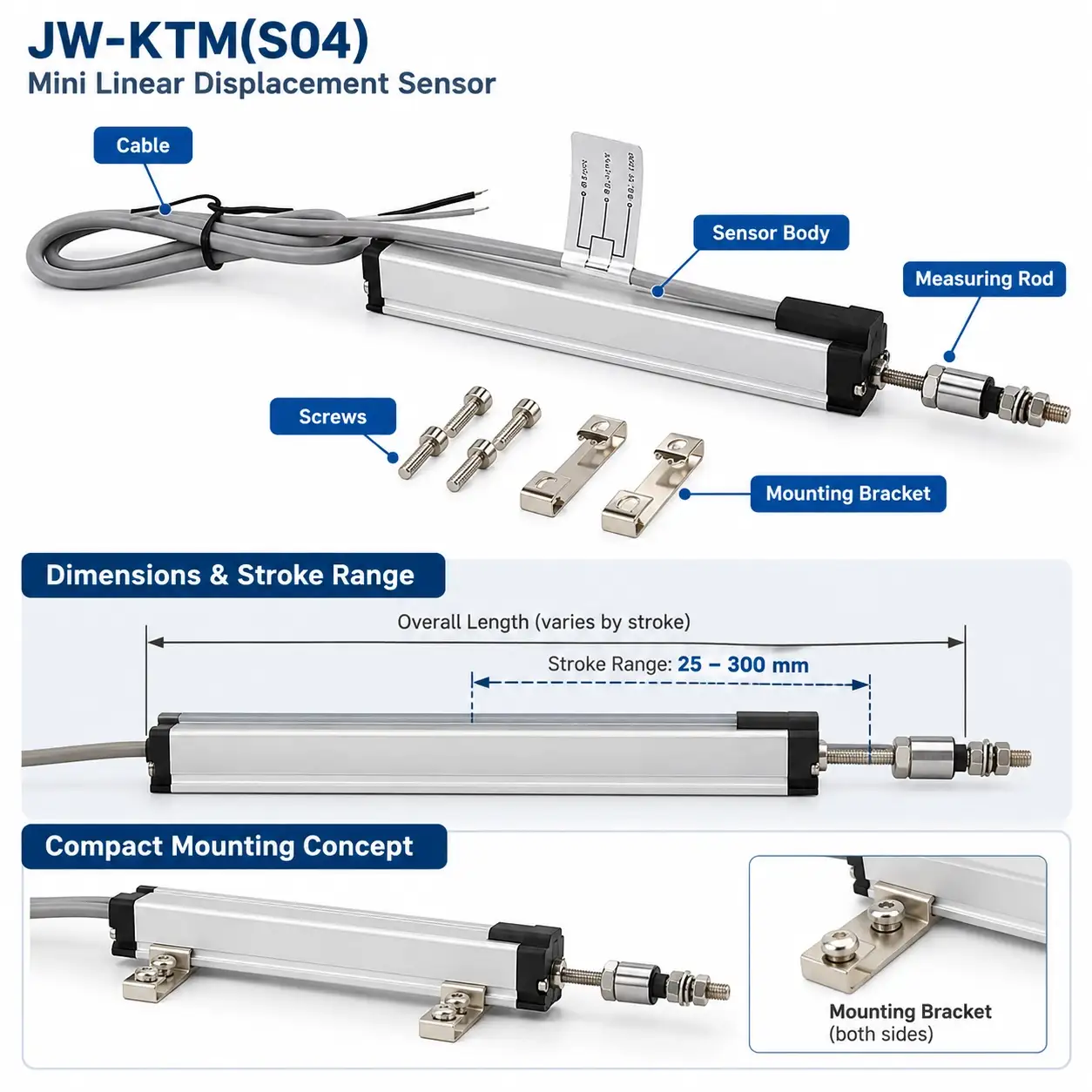
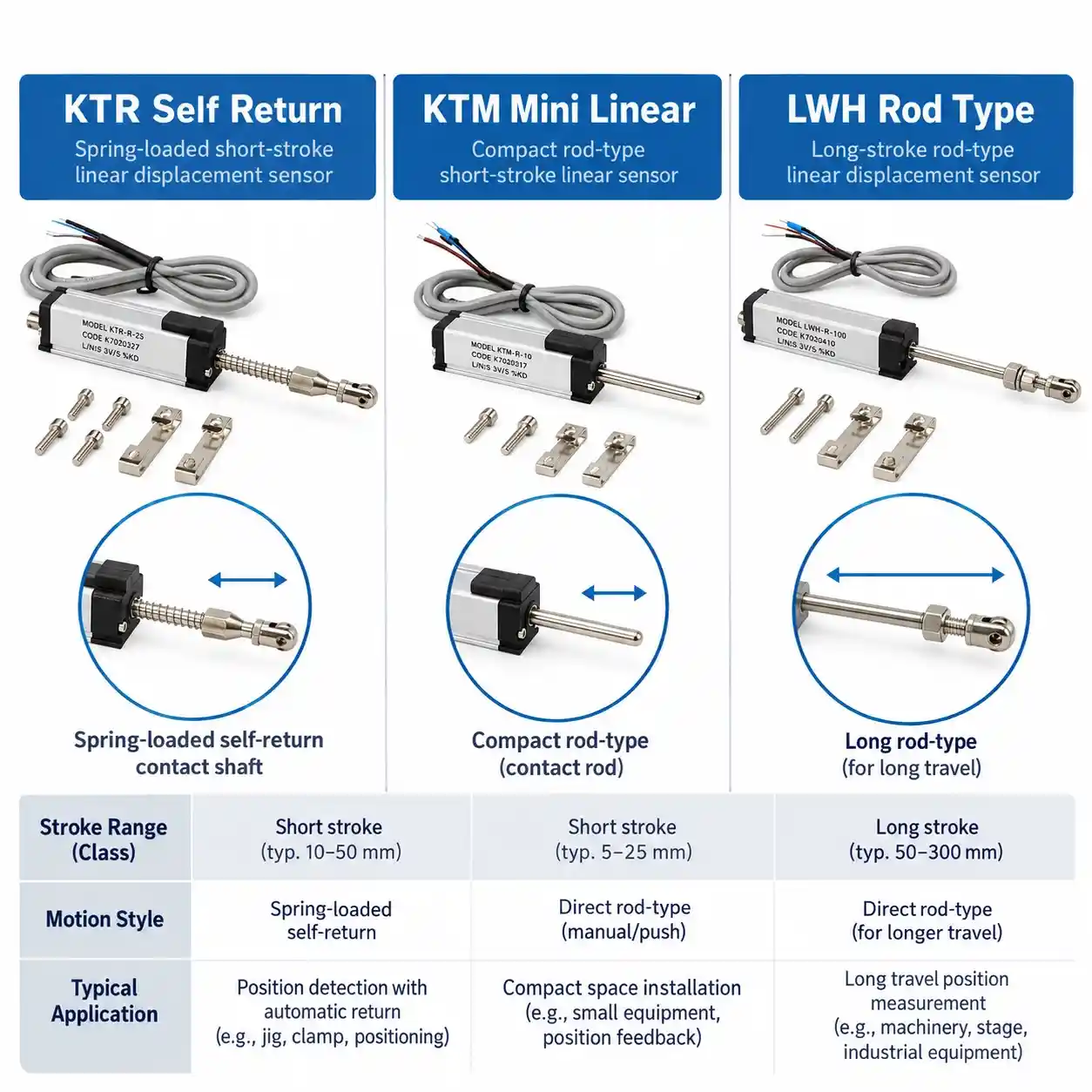
5. KTR Self Return vs KTM Mini Linear Sensors
Although both models use conductive plastic potentiometric sensing, their mechanical operation differs.
Recurso
KTR Self Return
KTM Mini Linear
Medição do AVC
5–100 mm
25–300 mm
Return Mechanism
Internal Spring
External Mechanical Movement
Método de medição
Spring-Loaded Contact
Direct Rod Coupling
Principal vantagem
Automatic Return
Compact Continuous Position Feedback
Aplicação típica
Thickness and Flatness Inspection
Machine Position Monitoring
Escolha o KTR self-return sensor when the application benefits from spring-loaded contact measurement.
1. What is a self return linear displacement sensor?
A
It is a linear position sensor with a built-in return spring that moves its measuring shaft toward the initial position when the external contact force is released.
Q
2. What is the measuring range of JW-KTR(S05)?
A
The product provides selectable measuring strokes from 5mm to 100mm.
Q
3. What is the difference between self-return and standard linear sensors?
A
A self-return sensor uses an internal spring for automatic shaft recovery. A conventional rod-type sensor generally depends on an external mechanical connection for movement.
Q
4. Is the KTR sensor suitable for thickness measurement?
A
Yes, in appropriately designed contact measurement fixtures where spring force, calibration and target geometry are suitable.
Q
5. What output signals are available?
A
Standard potentiometric resistance output is listed, with optional 4–20mA, 0–5V, 0–10V and RS485 configurations.
Q
6. Can the sensor connect to a PLC?
A
Yes. Compatible output configurations can be connected to an appropriate PLC input or signal-conditioning module.
Q
7. What is the protection rating?
A
The listed protection rating is IP65. This does not indicate suitability for immersion.
Q
8. How long is the mechanical service life?
A
The product documentation specifies more than 50 million operating cycles under applicable conditions.
 +86 13520127780
 info@jingelway.com