+86 13520127780
  info@jingelway.com








When Does a Solar Project Need a Class A Pyranometer?
Release time: 2026-09-08
Solar irradiance is one of the most important reference measurements in photovoltaic monitoring.
However, not every solar project requires the same level of radiation measurement performance.
A small rooftop installation, a distributed commercial PV system, a utility-scale solar farm and a meteorological research station may all measure sunlight, but they do so for different reasons and with different expectations for data quality.
That creates an important engineering question:
When does a project actually benefit from using a Class A pyranometer rather than a more general solar radiation sensor?
The answer depends less on the size of the sensor and more on how the irradiance data will be used.
If solar radiation data is only needed for basic environmental observation, a simpler irradiance sensor may be sufficient. If the data becomes an important reference for PV performance comparison, long-term trend analysis, plant diagnostics or professional meteorological monitoring, the requirements become significantly higher.
This guide explains how to make that decision from a system-design perspective.
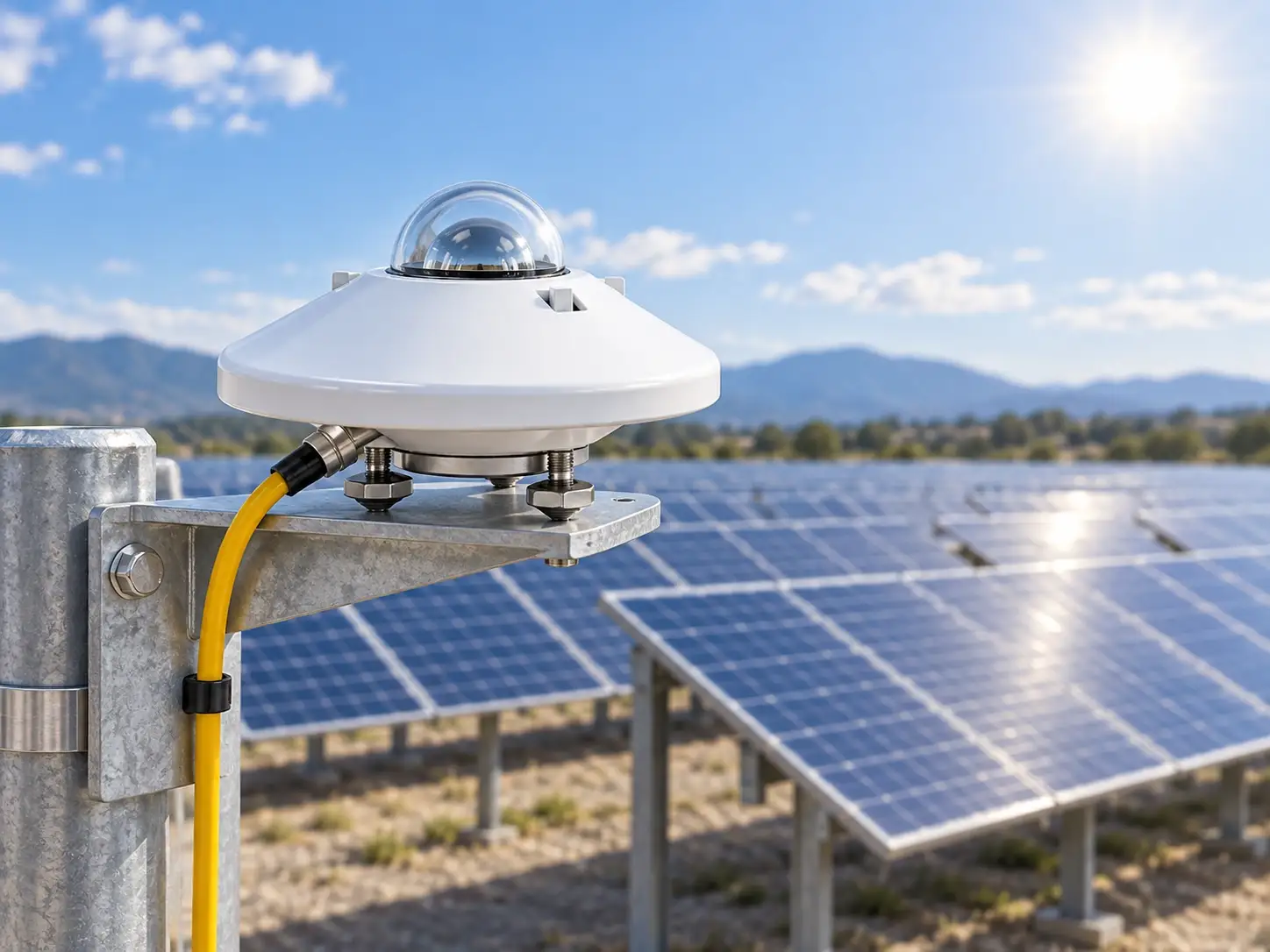
Why Irradiance Measurement Quality Matters in PV Monitoring
A photovoltaic plant cannot be evaluated only from its electrical output.
A reduction in power generation does not automatically mean that modules, inverters or cables are malfunctioning. Output can change simply because the available solar radiation has changed.
For this reason, irradiance measurements provide an environmental reference against which electrical generation can be interpreted.
A monitoring system may combine:
- irradiancia solar
- Temperatura del módulo fotovoltaico
- Temperatura ambiente
- Condiciones del viento
- Other weather parameters
- Datos de generación de energía
When these datasets are viewed together, operators gain a clearer picture of whether changing output is associated with weather conditions or whether further inspection of the PV system may be necessary.
JW-IoT provides a broader Solar Irradiance Sensor for PV Monitoring solution for projects that need to integrate irradiance measurement with module temperature, weather sensors, communication equipment and remote monitoring.
The more important irradiance data becomes to the analysis, the more important the measurement instrument becomes.
1. When Irradiance Is Used as a Performance Reference
One of the strongest reasons to consider a higher-performance pyranometer is when irradiance is not simply being displayed on a dashboard but is being used as a reference variable.
Consider two different monitoring situations.
In the first, a facility manager only wants to see whether solar radiation is currently high or low.
In the second, a PV operator wants to compare solar energy availability with power generation trends over months or years.
These two applications place very different demands on the radiation sensor.
For long-term plant monitoring, changes in sensor performance can gradually affect comparisons between irradiance and electrical generation. Stability therefore becomes increasingly important when data is intended to support historical analysis.
The JW-IoT Piranómetro de clase A con sensor de radiación solar is specified with annual stability below 1%, making it particularly relevant where long-term irradiance datasets form an important part of plant monitoring.
2. When Weather Conditions Change Quickly
Solar irradiance is not always stable.
Passing clouds can produce rapid transitions between high and low radiation conditions. These changes may occur much faster than general hourly weather trends.
If the objective is only to record daily environmental conditions, capturing every short-term fluctuation may not be essential.
For more detailed PV monitoring, however, sensor response becomes more relevant.
A faster radiation sensor can follow changing sunlight conditions more closely, producing irradiance data that is better synchronized with measurements from the electrical monitoring system.
The JW-TBQ-2H(LC25) Class A model has a specified response time of less than 7 seconds.
This can be valuable for locations with highly variable cloud conditions or monitoring systems where short-term irradiance changes are compared with PV power output.
3. When the Pyranometer Becomes Part of a PV Weather Station
Many solar projects do not operate a pyranometer as an independent instrument.
Instead, the sensor becomes one component of a larger PV environmental monitoring system.
A typical architecture can look like:
Pyranometer → Data Logger / RTU → Communication Network → Monitoring Platform
Other sensors may be connected to the same acquisition system, including:
- Sensores de temperatura del módulo
- Sensores de temperatura y humedad ambiente
- Sensores de velocidad y dirección del viento
- pluviómetros
- Barometric pressure sensors
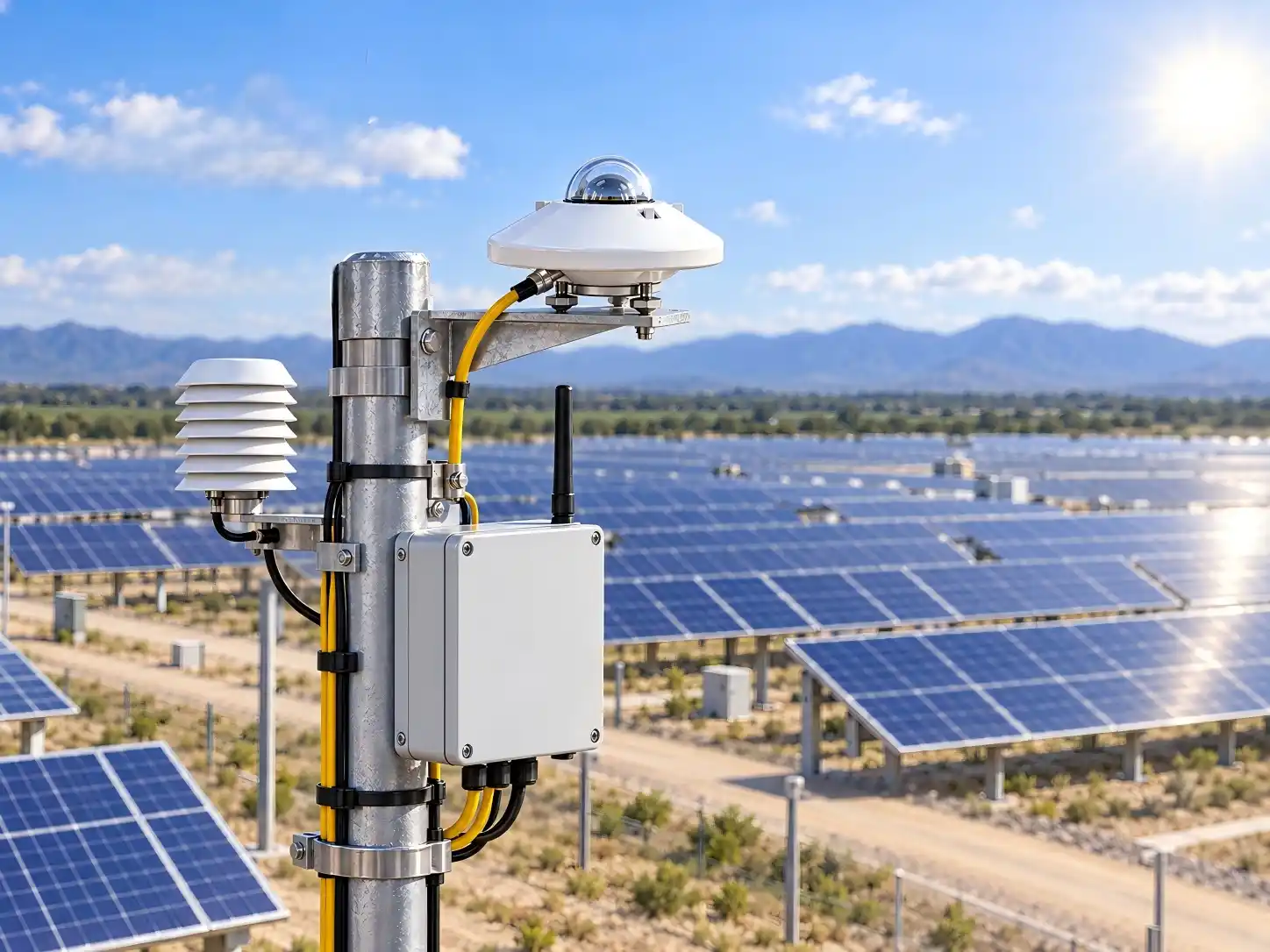
JW-IoT Solución de estación meteorológica para plantas fotovoltaicas combines solar radiation monitoring with environmental measurements, data acquisition, communication and cloud-based monitoring.
For projects requiring a complete station rather than an individual sensor, the Estación meteorológica solar fotovoltaica para la monitorización de centrales eléctricas. provides another system-level option.
The key point is that selecting a pyranometer should not be separated from selecting the monitoring architecture around it.
4. When RS485 Integration Can Simplify the Monitoring System
Sensor performance is only one part of a successful installation.
The measurement must also reach the monitoring system reliably.
Solar farms and industrial PV projects commonly use distributed data acquisition architectures. Sensors may connect to:
- Registradores de datos
- Unidades de radio (RTU)
- PLC
- Puertas de enlace
- Controladores de estaciones meteorológicas
- Plant monitoring systems
For these projects, digital communication can simplify field integration.
The JW-IoT Class A pyranometer is available with an integrated RS485 output option, alongside 0–20mV and 4–20mA configurations.
An RS485 configuration can be useful where the plant already operates an RS485 sensor network because the pyranometer can be included within the existing field communication architecture rather than requiring a separate signal conversion arrangement.
Projects requiring additional gateways, RTUs or transmission devices can also explore JW-IoT’s Dispositivos de comunicación for sensor-to-platform connectivity.
The correct output should therefore be chosen according to the data acquisition system—not simply according to the sensor specification.
5. Class A Pyranometer or General Irradiance Sensor?
Higher performance does not automatically mean that every project should choose the highest available sensor class.
A more practical question is:
What decisions will be made using the data?
A general irradiance sensor may be sufficient when:
- Solar radiation is mainly an environmental reference
- The project requires basic solar intensity monitoring
- Cost and compact installation are higher priorities
- Long-term precision comparison is not the main objective
- The sensor forms part of a large distributed network with moderate measurement requirements
JW-IoT also offers alternative technologies such as the Sensor de irradiancia de silicio para la monitorización del rendimiento fotovoltaico. for PV-oriented monitoring applications.
A Class A pyranometer becomes more relevant when:
- Irradiance is an important reference for PV performance analysis
- Long-term dataset consistency matters
- Rapid sunlight changes need to be captured more effectively
- The instrument is used in professional weather monitoring
- The project requires a broad solar radiation measurement range
- The sensor must integrate into a high-quality PV weather monitoring system
This approach avoids overspecifying simple projects while still protecting data quality where irradiance measurements have higher operational value.
6. Sensor Placement Can Matter as Much as Sensor Selection
A high-performance pyranometer cannot compensate for poor installation.
Even a carefully selected radiation sensor may produce unrepresentative data if it is installed in the wrong location.
Several practical questions should be answered before installation.
Is the measurement point representative?
The pyranometer should represent the solar conditions relevant to the area being monitored.
Avoid locations that experience unusual shading from:
- Edificios cercanos
- Polos
- Antenas de comunicación
- Weather station structures
- Árboles
- Other equipment
A sensor located in an unrepresentative micro-environment may generate technically valid measurements that are still unsuitable for plant-wide interpretation.
Are you measuring horizontal or array-plane irradiance?
The required mounting orientation depends on the monitoring objective.
A horizontal measurement provides a different reference from a sensor mounted parallel to the PV modules.
For PV performance monitoring, some projects use irradiance measurements in the same plane as the modules so the radiation measurement more closely represents the solar energy reaching the array.
Other projects also require horizontal reference measurements.
The monitoring objective should therefore be defined before selecting the mounting arrangement.
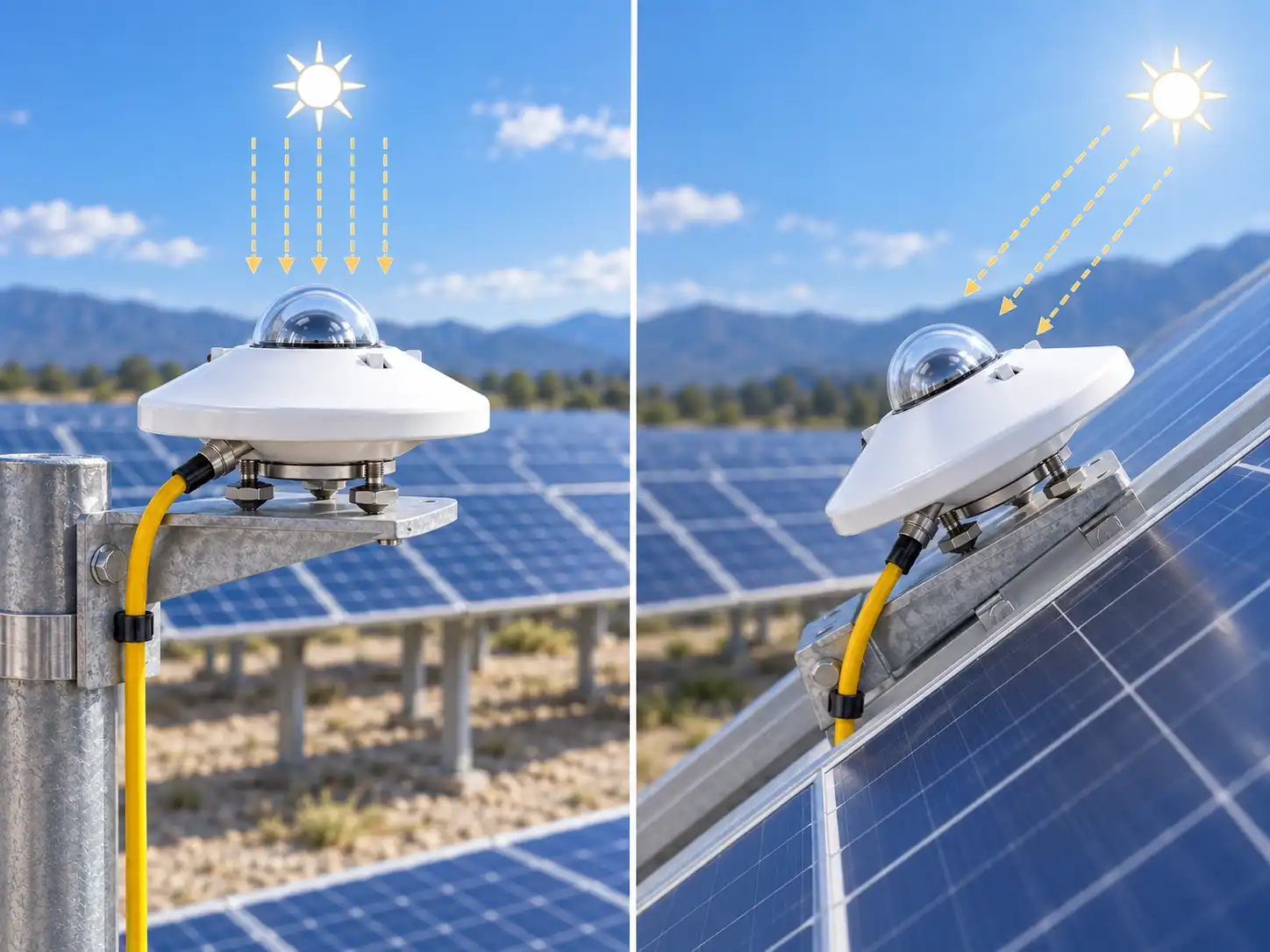
Can the sensor remain level and mechanically stable?
Mechanical movement can gradually change the orientation of the sensor.
The mounting structure should therefore remain stable under long-term outdoor conditions.
This is particularly important on:
- Azoteas
- Tracking structures
- Floating PV installations
- Wind-exposed sites
- Temporary monitoring structures
7. Think Beyond the Pyranometer: Build a Data Chain
A common mistake in environmental monitoring projects is focusing heavily on sensor specifications while paying less attention to what happens after the sensor produces data.
A complete irradiance monitoring chain includes several layers:
radiación solar
↓
Piranómetro
↓
Adquisición de datos
↓
Comunicación
↓
Almacenamiento
↓
Visualization and Analysis
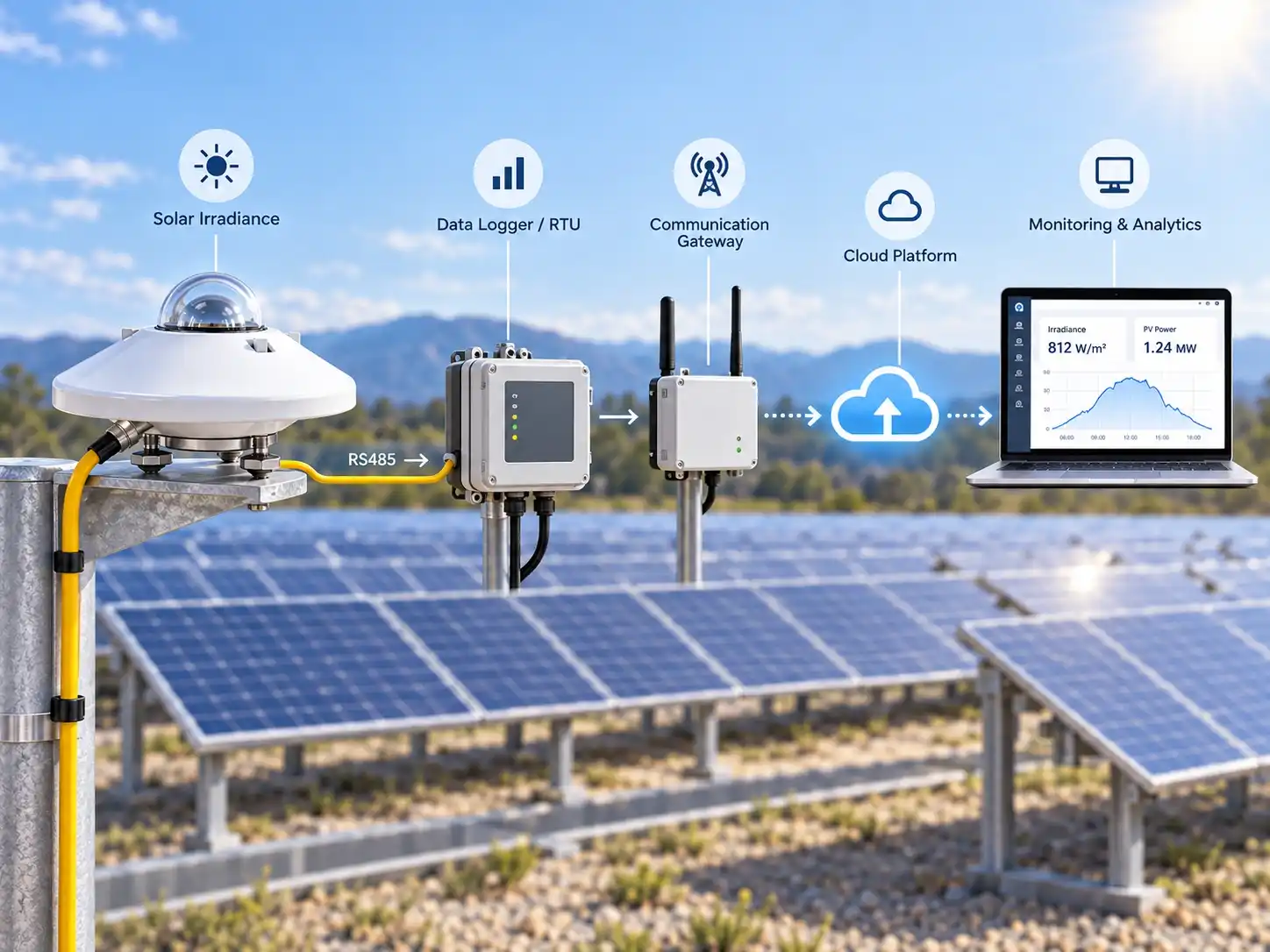
Every layer can influence whether the final data is useful.
For example, project engineers should define:
- Intervalo de muestreo
- Data logging interval
- Método de comunicación
- Sensor address management
- Sincronización horaria
- Data storage strategy
- Integración de plataforma
- Data export requirements
Selecting the pyranometer first and solving these questions afterward can create unnecessary integration work.
For a complete architecture, JW-IoT’s Solución de estación meteorológica para plantas fotovoltaicas shows how weather sensors, data acquisition equipment, communications and cloud monitoring can work together.
8. Long-Term Data Quality Requires Maintenance
Radiation monitoring should not be treated as a completely maintenance-free process.
A pyranometer installed outdoors is continuously exposed to environmental conditions.
Depending on the site, the sensor surface can be affected by:
- Polvo
- Polen
- Salt deposits
- Partículas industriales
- Bird contamination
- Snow or ice
- Water residue
Contamination can influence how much radiation reaches the sensing element.
Maintenance planning should therefore be considered during system design rather than after inaccurate measurements appear.
A practical monitoring program may include:
- Inspección visual periódica
- Cleaning according to site conditions
- Comprobación de la estabilidad del montaje
- Inspección de cables y conectores
- Reviewing irradiance data for unusual shifts or discontinuities
- Following the manufacturer’s recommended verification or calibration procedures
The required inspection frequency depends heavily on the environment.
A desert solar farm and an urban rooftop, for example, may require very different maintenance intervals.
9. Where Class A Pyranometers Fit in Different Solar Projects
Utility-Scale PV Plants
Large plants often depend heavily on environmental reference data.
A Class A pyranometer can form part of a professional PV weather monitoring station used to understand irradiance conditions across the plant and compare solar resource changes with generation trends.
Fotovoltaica en azoteas comerciales e industriales
Not every rooftop system requires a Class A sensor.
However, larger commercial systems that depend on detailed long-term performance monitoring may benefit from higher-quality irradiance data, particularly where system owners want to distinguish environmental variation from equipment-related performance changes.
Distributed PV Networks
Distributed PV projects create another challenge: one weather measurement may not represent every location.
In these cases, the monitoring strategy may require a combination of higher-quality reference stations and additional distributed measurement points.
Floating PV
Floating installations introduce different environmental and mechanical considerations, including humidity, wind exposure and movement of the floating structure.
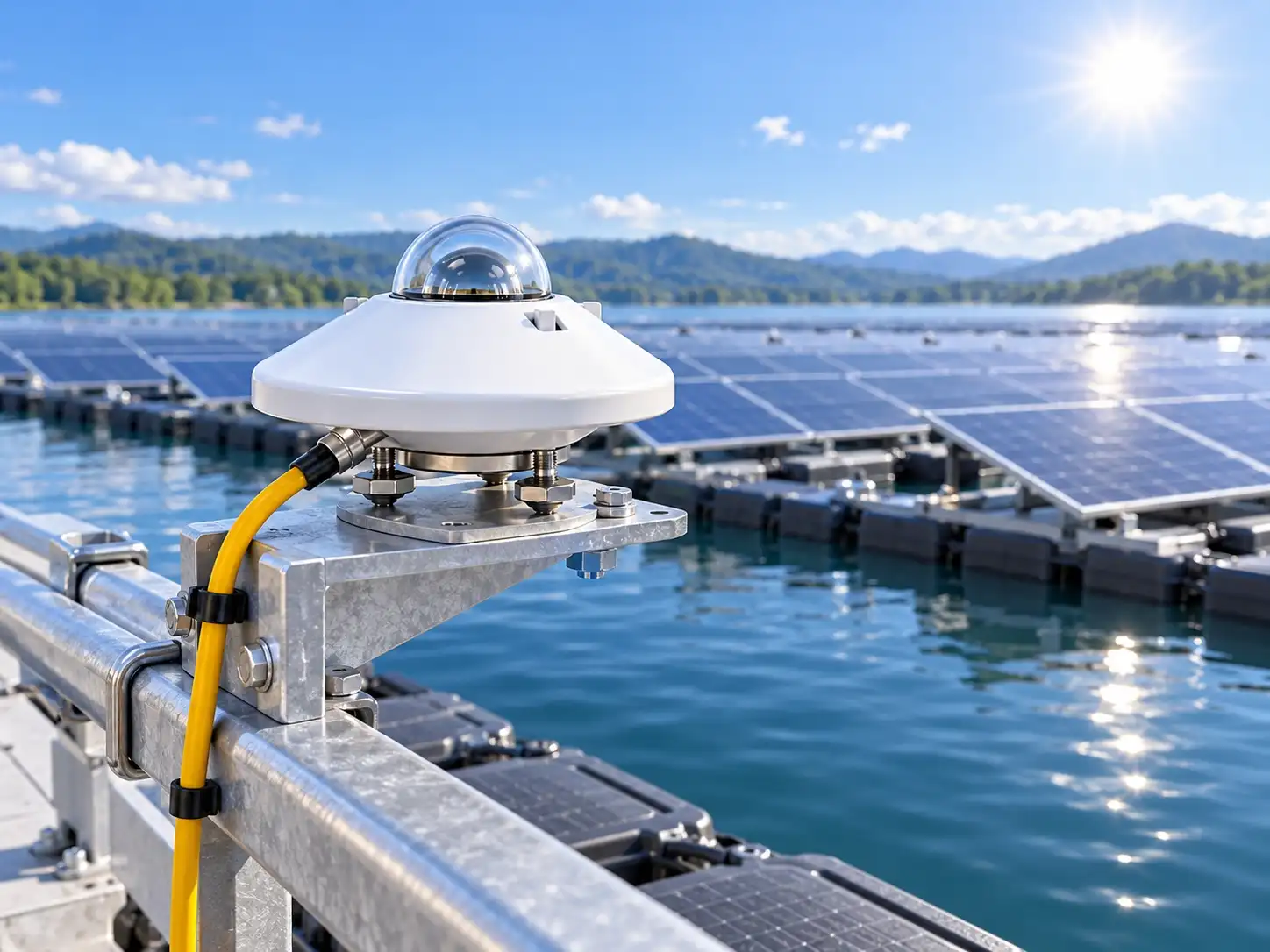
JW-IoT proporciona un servicio dedicado Solución de estación flotante de monitoreo solar for environmental monitoring around reservoir and lake-based PV projects.
Meteorological and Solar Resource Monitoring
Where the main objective extends beyond plant operation into solar resource observation or professional meteorological monitoring, sensor stability and response characteristics become even more important.
A Class A pyranometer is therefore more naturally suited to projects where radiation measurement itself is a primary data requirement.
10. Questions to Ask Before Choosing a Pyranometer
Before specifying a solar radiation sensor, project engineers can use the following checklist.
Measurement objective
What will the irradiance data actually be used for?
Duración del seguimiento
Is this a temporary test, a short-term project or a multi-year monitoring installation?
Required response
Does the application need to capture rapid irradiance changes?
Installation orientation
Will the sensor measure horizontal radiation, array-plane radiation or both?
Data acquisition
Will the sensor connect to a data logger, RTU, PLC or weather station controller?
Señal de salida
Does the existing system require mV, 4–20mA or RS485?
Arquitectura de comunicación
Will the data remain local or be transmitted to a remote monitoring platform?
Site conditions
Will dust, high humidity, extreme temperatures or difficult access affect maintenance?
Answering these questions usually produces a better sensor selection than choosing solely from a specification table.
JW-IoT Class A Pyranometer for Solar Monitoring Projects
For applications where stable, responsive solar radiation measurement and straightforward monitoring-system integration are important, JW-IoT provides the Sensor de radiación solar de piranómetro de clase A JW-TBQ-2H(LC25).
Key specifications include:
- Spectral range: 285–2800 nm
- Response time: <7 seconds
- Annual stability: <1%
- Operating temperature: -40°C a 80°C
- Output options: 0–20mV, 4–20mA and RS485
The sensor can be integrated into PV weather stations, solar monitoring systems, data loggers and RTU-based monitoring architectures.
View the full product specifications:
Piranómetro de clase A, sensor de radiación solar con salida RS485
Preguntas frecuentes
1. What is a Class A pyranometer used for?
A Class A pyranometer is suitable for applications where high-quality solar irradiance measurements are required, including PV plant monitoring, professional weather stations, solar resource observation and environmental research.
2. Is a Class A pyranometer necessary for every solar plant?
No. The correct sensor depends on how the irradiance data will be used. Basic environmental monitoring may not require the same measurement performance as long-term PV performance analysis or professional meteorological monitoring.
3. Why does pyranometer response time matter?
Solar radiation can change quickly when clouds move across the sun. A faster sensor can follow these short-term irradiance changes more closely, which may improve synchronization between radiation and PV power measurements.
4. Can a Class A pyranometer connect directly to an RS485 monitoring network?
The JW-TBQ-2H(LC25) is available with an integrated RS485 output option. It can therefore be configured for integration with compatible data acquisition and monitoring systems.
5. Should a pyranometer be installed horizontally or parallel to PV modules?
That depends on what the project needs to measure. Horizontal and plane-of-array measurements answer different monitoring questions. The required measurement geometry should be defined before determining the sensor mounting position.
6. What other sensors should be used with a pyranometer at a PV plant?
PV monitoring systems commonly combine irradiance measurements with module temperature and other environmental parameters. The final sensor configuration should be based on the performance analysis and O&M requirements of the project.
Conclusión
Choosing a pyranometer should not begin with the question, “Which sensor has the highest specification?”
A better question is:
How important will irradiance data be to the decisions made by the monitoring system?
If solar radiation is simply an additional environmental parameter, a general irradiance sensor may be appropriate.
If irradiance becomes a long-term reference for PV performance monitoring, changing-weather analysis, professional meteorological observation or solar resource assessment, the stability and response characteristics of a Class A pyranometer become more valuable.
Just as importantly, accurate measurement depends on more than the sensor itself.
Correct placement, appropriate mounting, reliable data acquisition, communication architecture and long-term maintenance all contribute to the quality of the final irradiance dataset.
For projects requiring professional solar radiation measurement or a complete PV environmental monitoring architecture, explore the JW-IoT Class A Pyranometer o el Solución de estación meteorológica para plantas fotovoltaicas.
Need help selecting the right irradiance sensor, output signal or PV weather monitoring architecture? Contact JW-IoT with your project type, monitoring parameters, data acquisition method and communication requirements for a project-based configuration recommendation.